

- University
- Academic
- Schools/Vocational Schools
- Vocational School of Justice
- Vocational School
- Vocational School
- Department of Banking and Insurance (Turkish)
- Department of Computer Programming (Turkish)
- Department of Foreign Trade (Turkish)
- Department of Graphic Design (Turkish)
- Department of Interior Design (Turkish)
- Department of Construction Technology (Turkish)
- Department of Occupational Health and Safety (Turkish)
- Department of Media and Communication (Turkish)
- Department of Architectural Restoration (Turkish)
- Department of Radio and Tv Programming (Turkish)
- Department of Civil Aviation Cabin Services (Turkish)
- Department of Civil Aviation Transportation Management (Turkish)
- Department of Tourism and Hotel Management (Turkish)
- Department of Applied English Translation
- Vocational School Of Health Services
- Vocational School Of Health Services
- Department of Child Development (Turkish)
- Department of Physiotherapy (Turkish)
- Department of Paramedic (Turkish)
- Department of Opticianry (Turkish)
- Department of Medical Documentation and Secreteriat (Turkish)
- Department of Medical Imaging Techniques (Turkish)
- Department of Medical Laboratory Techniques (Turkish)
- Department of Elderly Care (Turkish)
- School of Applied Management Sciences
- School of Foreign Languages
- Faculties
- Faculty of Arts and Sciences
- Faculty of Fine Arts and Design
- Faculty of Law
- Faculty of Communication
- Faculty of Business
- Faculty of Engineering
- Faculty of Engineering
- Department of Computer Engineering
- Department of Biomedical Engineering
- Department of Electrical and Electronics Engineering
- Department of Industrial Engineering
- Department of Food Engineering
- Department of Genetics and Bioengineering
- Department of Aerospace Engineering
- Department of Civil Engineering
- Department of Mechanical Engineering
- Department of Mechatronics Engineering
- Department of Software Engineering
- Faculty of Health Sciences
- Medicine
- Graduate School
- Common Courses
- Schools/Vocational Schools
- Research
- Research Centers
- Library
- Smart Campus
- Technology Transfer Office
- İzmir Sciencepark
- Continuous Education Center (EKOSEM)
- Children's University
- Ethics Committee
- Teaching and Learning Center (EKOEĞİTİM)
- Psychology Application and Research Center
- Researcher Training Coordinatorship
- Research Collaborations And Innovation Coordinatorship
- Campus
- INTERNATIONAL
- Contact
- 25TH YEAR
FACULTY OF FINE ARTS AND DESIGN
Department of Interior Architecture and Environmental DesignIAED 355 | Course Introduction and Application Information
| Course Name |
Lighting for Interiors
|
|
Code
|
Semester
|
Theory
(hour/week) |
Application/Lab
(hour/week) |
Local Credits
|
ECTS
|
|
IAED 355
|
Fall/Spring
|
2
|
2
|
3
|
4
|
| Prerequisites |
None
|
|||||
| Course Language |
English
|
|||||
| Course Type |
Elective
|
|||||
| Course Level |
First Cycle
|
|||||
| Mode of Delivery | face to face | |||||
| Teaching Methods and Techniques of the Course | DiscussionProblem SolvingCritical feedbackLecture / Presentation | |||||
| National Occupation Classification | - | |||||
| Course Coordinator | ||||||
| Course Lecturer(s) | ||||||
| Assistant(s) | - | |||||
| Course Objectives | This course aims to develop students' knowledge and skills in designing functional and visually appealing interior lighting solutions. It focuses on creating dynamic, user-centered lighting scenarios that emphasize both natural and, artificial light, thereby enhancing well-being, user experience, and energy efficiency. |
| Learning Outcomes |
The students who succeeded in this course;
|
| Course Description | This course covers the fundamentals of lighting design in interior spaces, including ambient lighting, task lighting, and accent lighting. Additionally, the course will include hands-on projects focused on creating user-centered and sustainable lighting solutions, utilizing important technical terms such as the combined use of natural and artificial light, color and brightness management, CRI, and lighting levels. This course covers the fundamentals of lighting design in interior spaces, including ambient lighting, task lighting, and accent lighting. Additionally, the course will include hands-on projects focused on creating user-centered and sustainable lighting solutions, utilizing important technical terms such as the combined use of natural and artificial light, color and brightness management, CRI, and lighting levels. This course covers the fundamentals of lighting design in interior spaces, including ambient lighting, task lighting, and accent lighting. Additionally, the course will include hands-on projects focused on creating user-centered and sustainable lighting solutions, utilizing important technical terms such as the combined use of natural and artificial light, color and brightness management, CRI, and lighting levels. |
| Related Sustainable Development Goals |
|
|
|
Core Courses | |
| Major Area Courses |
X
|
|
| Supportive Courses | ||
| Media and Management Skills Courses | ||
| Transferable Skill Courses |
WEEKLY SUBJECTS AND RELATED PREPARATION STUDIES
| Week | Subjects | Related Preparation |
| 1 | * Introduction to IAED 355, brief, semester syllabus * Overview of the course objectives and expectations | No preparation |
| 2 | * Introduction to Lighting Design * Daylighting and Principles | Kilmer, R., & Kilmer, W. O. (2024). Designing interiors (2nd ed.). Hoboken, NJ, United States: John Wiley & Sons. (Chapter 12) |
| 3 | Lighting Fixtures * In-depth study of lighting fixtures (incandescent, fluorescent, LED, etc.) * Selecting appropriate fixtures for different applications and different spaces | Innes, M. (2012). Lighting for interior design (Portfolio Skills). London, United Kingdom: Laurence King Publishing |
| 4 | Types of Artificial Lighting * Exploration of ambient, task, and accent lighting * Understanding the characteristics and uses of different lighting types | |
| 5 | Color Temperature and Light Quality + Quiz *Exploring color temperature and its effects on atmosphere *Introduction to the Color Rendering Index (CRI) | Preparing for Quiz |
| 6 | Announcing of the Ass. 1 (board presentation electrical plan and lighting table) + Guest Lecturer | Research about the guest |
| 7 | Brightness, Glare, Reflectors, and Diffusers + critiques | Preparing for Ass. 1 |
| 8 | Midterm Week (no class) | |
| 9 | Illumination Levels, Measurements and lighting table + critiques | Preparing for Ass. 1 |
| 10 | Submission of Ass. 1 and presentations | Ass. 1 boards and presentation |
| 11 | Integrating Daylight and Artificial Light and Human-Centric Lighting Design | Livingston, J. (2014). Designing with Light: The art, science, and practice of architectural lighting design (1st ed.). Hoboken, NJ, United States: Wiley. |
| 12 | Announcing of the Ass. 2 (Lighting scenarios, lighting table and detailed electrical and ceiling plan with legend) + Critiques | Scaled ceiling plan, electrical plan printouts and lighting table |
| 13 | Lighting Scenarios + Critiques *Designing dynamic lighting scenarios tailored to specific environments | Scaled ceiling plan, electrical plan printouts and lighting table |
| 14 | Critiques for Ass. 2 | Scaled ceiling plan, electrical plan printouts and lighting table |
| 15 | Ass. 2 presentations (Lighting scenarios, lighting table and detailed and scaled electrical and ceiling plan with legend) | Completion of the Ass. 2. |
| 16 | Semester review |
| Course Notes/Textbooks | Cupkova, D., Kajati, E., Mocnej, J., Papcun, P., Koziorek, J., & Zolotova, I. (2019). Intelligent human-centric lighting for mental wellbeing improvement. International Journal of Distributed Sensor Networks, 15(9). https://doi.org/10.1177/1550147719875878 Innes, M. (2012). Lighting for interior design (Portfolio Skills). London, United Kingdom: Laurence King Publishing. Kilmer, R., & Kilmer, W. O. (2024). Designing interiors (2nd ed.). Hoboken, NJ, United States: John Wiley & Sons. Livingston, J. (2014). Designing with Light: The art, science, and practice of architectural lighting design (1st ed.). Hoboken, NJ, United States: Wiley. |
| Suggested Readings/Materials |
EVALUATION SYSTEM
| Semester Activities | Number | Weigthing |
| Participation |
1
|
15
|
| Laboratory / Application | ||
| Field Work | ||
| Quizzes / Studio Critiques |
1
|
20
|
| Portfolio | ||
| Homework / Assignments |
1
|
25
|
| Presentation / Jury | ||
| Project |
1
|
40
|
| Seminar / Workshop | ||
| Oral Exams | ||
| Midterm | ||
| Final Exam | ||
| Total |
| Weighting of Semester Activities on the Final Grade |
4
|
100
|
| Weighting of End-of-Semester Activities on the Final Grade | ||
| Total |
ECTS / WORKLOAD TABLE
| Semester Activities | Number | Duration (Hours) | Workload |
|---|---|---|---|
| Theoretical Course Hours (Including exam week: 16 x total hours) |
16
|
2
|
32
|
| Laboratory / Application Hours |
16
|
2
|
32
|
| Study Hours Out of Class |
14
|
1
|
14
|
| Field Work |
0
|
||
| Quizzes / Studio Critiques |
1
|
7
|
7
|
| Portfolio |
0
|
||
| Homework / Assignments |
1
|
15
|
15
|
| Presentation / Jury |
0
|
||
| Project |
1
|
20
|
20
|
| Seminar / Workshop |
0
|
||
| Oral Exam |
0
|
||
| Midterms |
0
|
||
| Final Exam |
0
|
||
| Total |
120
|
COURSE LEARNING OUTCOMES AND PROGRAM QUALIFICATIONS RELATIONSHIP
|
#
|
Program Competencies/Outcomes |
* Contribution Level
|
|||||
|
1
|
2
|
3
|
4
|
5
|
|||
| 1 |
To be able to perform, execute and manage the various responsibilities and duties of an interior architecture and environmental design professional |
-
|
X
|
-
|
-
|
-
|
|
| 2 |
To be able to recognize, analyze and integrate within their practice the particular local and regional needs and developments of their profession |
X
|
-
|
-
|
-
|
-
|
|
| 3 |
To be able to communicate and collaborate with other individuals and groups on a national and international level within their profession |
X
|
-
|
-
|
-
|
-
|
|
| 4 |
To be able to develop, integrate and promote independent critical approaches for their professional practice |
-
|
-
|
-
|
-
|
-
|
|
| 5 |
To be able to understand the social and environmental issues and responsibilities of their profession |
-
|
-
|
-
|
-
|
-
|
|
| 6 |
To be able identify, assess and utilize the most up to date research, innovations, trends and technologies |
-
|
-
|
X
|
-
|
-
|
|
| 7 |
To be able to consider the national and international standards and regulations of their field |
-
|
-
|
-
|
-
|
-
|
|
| 8 |
To be able to develop the abilities to communicate and present design ideas within visual, oral and textual formats |
X
|
-
|
-
|
-
|
-
|
|
| 9 |
To be able to adopt a multidisciplinary approach to design on a national and international level |
X
|
-
|
-
|
-
|
-
|
|
| 10 |
To be able to recognize their own strengths, and develop them within an environment |
-
|
-
|
-
|
-
|
-
|
|
| 11 |
To be able to collect data in the areas of interior architecture and environmental design and communicate with colleagues in a foreign language |
X
|
-
|
-
|
-
|
-
|
|
| 12 |
To be able to speak a second foreign at a medium level of fluency efficiently |
-
|
-
|
-
|
-
|
-
|
|
| 13 |
To be able to relate the knowledge accumulated throughout the human history to their field of expertise |
-
|
-
|
-
|
-
|
-
|
|
*1 Lowest, 2 Low, 3 Average, 4 High, 5 Highest















NEWSALL NEWS


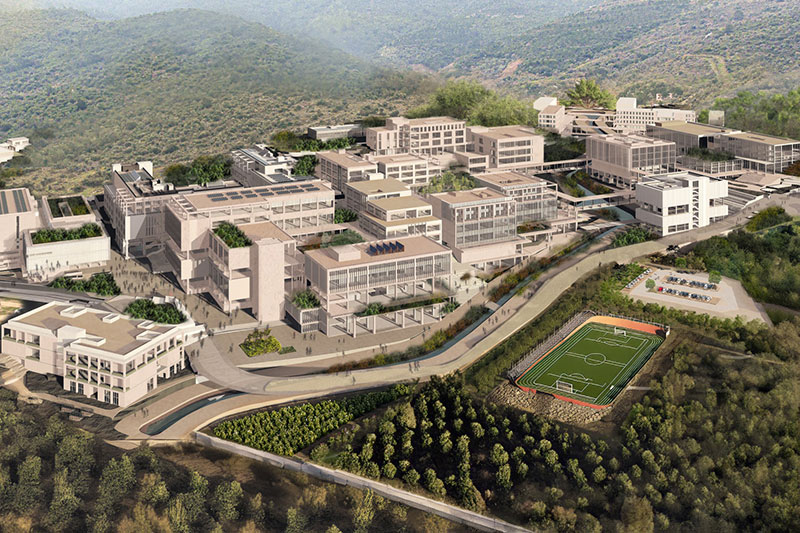
IZMIR UNIVERSITY OF ECONOMICS GÜZELBAHÇE CAMPUS
DetailsGLOBAL CAREER
As Izmir University of Economics transforms into a world-class university, it also raises successful young people with global competence.
More..CONTRIBUTION TO SCIENCE
Izmir University of Economics produces qualified knowledge and competent technologies.
More..VALUING PEOPLE
Izmir University of Economics sees producing social benefit as its reason for existence.
More..
You are one step ahead with your graduate education at Izmir University of Economics.