

- University
- Academic
- Schools/Vocational Schools
- Vocational School of Justice
- Vocational School
- Vocational School
- Department of Banking and Insurance (Turkish)
- Department of Computer Programming (Turkish)
- Department of Foreign Trade (Turkish)
- Department of Graphic Design (Turkish)
- Department of Interior Design (Turkish)
- Department of Construction Technology (Turkish)
- Department of Occupational Health and Safety (Turkish)
- Department of Media and Communication (Turkish)
- Department of Architectural Restoration (Turkish)
- Department of Radio and Tv Programming (Turkish)
- Department of Civil Aviation Cabin Services (Turkish)
- Department of Civil Aviation Transportation Management (Turkish)
- Department of Tourism and Hotel Management (Turkish)
- Department of Applied English Translation
- Vocational School Of Health Services
- Vocational School Of Health Services
- Department of Child Development (Turkish)
- Department of Physiotherapy (Turkish)
- Department of Paramedic (Turkish)
- Department of Opticianry (Turkish)
- Department of Medical Documentation and Secreteriat (Turkish)
- Department of Medical Imaging Techniques (Turkish)
- Department of Medical Laboratory Techniques (Turkish)
- Department of Elderly Care (Turkish)
- School of Applied Management Sciences
- School of Foreign Languages
- Faculties
- Faculty of Arts and Sciences
- Faculty of Fine Arts and Design
- Faculty of Law
- Faculty of Communication
- Faculty of Business
- Faculty of Engineering
- Faculty of Engineering
- Department of Computer Engineering
- Department of Biomedical Engineering
- Department of Electrical and Electronics Engineering
- Department of Industrial Engineering
- Department of Food Engineering
- Department of Genetics and Bioengineering
- Department of Aerospace Engineering
- Department of Civil Engineering
- Department of Mechanical Engineering
- Department of Mechatronics Engineering
- Department of Software Engineering
- Faculty of Health Sciences
- Medicine
- Graduate School
- Common Courses
- Schools/Vocational Schools
- Research
- Research Centers
- Library
- Smart Campus
- Technology Transfer Office
- İzmir Sciencepark
- Continuous Education Center (EKOSEM)
- Children's University
- Ethics Committee
- Teaching and Learning Center (EKOEĞİTİM)
- Psychology Application and Research Center
- Researcher Training Coordinatorship
- Research Collaborations And Innovation Coordinatorship
- Campus
- INTERNATIONAL
- Contact
- 25TH YEAR
FACULTY OF FINE ARTS AND DESIGN
Department of Interior Architecture and Environmental DesignIAED 345 | Course Introduction and Application Information
| Course Name |
Earthquake Resistant Interiors
|
|
Code
|
Semester
|
Theory
(hour/week) |
Application/Lab
(hour/week) |
Local Credits
|
ECTS
|
|
IAED 345
|
Fall/Spring
|
2
|
2
|
3
|
4
|
| Prerequisites |
None
|
|||||
| Course Language |
English
|
|||||
| Course Type |
Elective
|
|||||
| Course Level |
First Cycle
|
|||||
| Mode of Delivery | - | |||||
| Teaching Methods and Techniques of the Course | DiscussionGroup WorkProblem SolvingCritical feedbackApplication: Experiment / Laboratory / WorkshopLecture / Presentation | |||||
| National Occupation Classification | - | |||||
| Course Coordinator | ||||||
| Course Lecturer(s) | ||||||
| Assistant(s) | - | |||||
| Course Objectives | This course aims students both to understand the responsibility of designing earthquake resistant interiors and to acquire the necessary technical information to propose creative new solutions by considering existing applications. |
| Learning Outcomes |
The students who succeeded in this course;
|
| Course Description | This course scopes the design solutions for space planning, furniture, and details, which might be lifesaving in an earthquake, and manufacturing the model of proposed detail solutions. |
| Related Sustainable Development Goals |
|
|
|
Core Courses | |
| Major Area Courses | ||
| Supportive Courses |
X
|
|
| Media and Management Skills Courses | ||
| Transferable Skill Courses |
WEEKLY SUBJECTS AND RELATED PREPARATION STUDIES
| Week | Subjects | Related Preparation |
| 1 | Introduction to the Course Content | |
| 2 | Organization Levels: Country, City and District and The Role of Emergency Designers: Before, Right After and After the Earthquake | HW 1: Çıkış, Ş., Ergül, E., Studio 2: Disaster Conscious Urban Design, Architects and Disasters, Chamber of Architects of Turkey, pp.198-213, Ankara, ISBN: 975-395-891-9. |
| 3 | Presentation on Frame Structures: Reinforced Concrete Buildings Discussion on the Behavior of Elements in an Earthquake | HW 2: Ching, F. D. K., Binggeli, C., Interior Design Illustrated, Third Edition, pp. 147-218 (Chapter 4: Interior Building Elements), John Wiley and Sons, Inc., ISBN: 978-1-118-09071-8 (pbk). |
| 4 | Presentation on Rules: Subtractions and Additions Discussion on Ethics in Design | HW 3: Hürol, Y., (2013) On Ethics and the Earthquake Resistant Interior Design of Buildings, Science and Engineering Ethics, Vol: 20, No: 1, pp.171-181, doi: 10.1007/s11948-012-9424-1. |
| 5 | Space Planning: Life Saving Cages | HW 4: Students are going to make a space-planning sketch on the given project. |
| 6 | Fixed and Mobile Furniture | HW 5: Students are going to define a method of fixing an element for the given project. |
| 7 | Suspended Ceilings and Accessories | HW 6: Students are going to design a new structural system for the ceiling panels. |
| 8 | Details: Bars, Locks, Round and Soft Edges | HW 7: Students are going to prepare a list of preventions to be applied to the project. |
| 9 | Midterm Exam | |
| 10 | Drawing a Detail Proposal 1 | HW 8: Students will propose a detail for an interior element. |
| 11 | Drawing a Detail Proposal 2 | Students will bring the revision of the details. |
| 12 | Workshop Week 1 | Student groups are going to start to make the model of proposed detail. |
| 13 | Workshop Week 2 | Student groups are going to complete the model of proposed detail. |
| 14 | Final Presentation and Discussion | Students will submit and present the drawings and model of the detail. |
| 15 | Semester Review | |
| 16 | Semester Review |
| Course Notes/Textbooks | Çıkış, Ş., Ergül, E., Studio 2: Disaster Conscious Urban Design, Architects and Disasters, Chamber of Architects of Turkey, pp.198-213, Ankara, ISBN: 975-395-891-9. Ching, F. D. K., Binggeli, C., Interior Design Illustrated, Third Edition, pp. 147-218 (Chapter 4: Interior Building Elements), John Wiley and Sons, Inc., ISBN: 978-1-118-09071-8 (pbk). Hürol, Y., (2013) On Ethics and the Earthquake Resistant Interior Design of Buildings, Science and Engineering Ethics, Vol: 20, No: 1, pp.171-181, doi: 10.1007/s11948-012-9424-1. |
| Suggested Readings/Materials |
EVALUATION SYSTEM
| Semester Activities | Number | Weigthing |
| Participation |
1
|
20
|
| Laboratory / Application | ||
| Field Work | ||
| Quizzes / Studio Critiques | ||
| Portfolio | ||
| Homework / Assignments |
1
|
20
|
| Presentation / Jury |
1
|
20
|
| Project | ||
| Seminar / Workshop |
1
|
20
|
| Oral Exams | ||
| Midterm |
1
|
20
|
| Final Exam | ||
| Total |
| Weighting of Semester Activities on the Final Grade |
5
|
100
|
| Weighting of End-of-Semester Activities on the Final Grade | ||
| Total |
ECTS / WORKLOAD TABLE
| Semester Activities | Number | Duration (Hours) | Workload |
|---|---|---|---|
| Theoretical Course Hours (Including exam week: 16 x total hours) |
16
|
2
|
32
|
| Laboratory / Application Hours |
16
|
2
|
32
|
| Study Hours Out of Class |
14
|
1
|
14
|
| Field Work |
0
|
||
| Quizzes / Studio Critiques |
0
|
||
| Portfolio |
0
|
||
| Homework / Assignments |
8
|
2
|
16
|
| Presentation / Jury |
1
|
9
|
9
|
| Project |
0
|
||
| Seminar / Workshop |
2
|
4
|
8
|
| Oral Exam |
0
|
||
| Midterms |
1
|
9
|
9
|
| Final Exam |
0
|
||
| Total |
120
|
COURSE LEARNING OUTCOMES AND PROGRAM QUALIFICATIONS RELATIONSHIP
|
#
|
Program Competencies/Outcomes |
* Contribution Level
|
|||||
|
1
|
2
|
3
|
4
|
5
|
|||
| 1 |
To be able to perform, execute and manage the various responsibilities and duties of an interior architecture and environmental design professional |
-
|
-
|
X
|
-
|
-
|
|
| 2 |
To be able to recognize, analyze and integrate within their practice the particular local and regional needs and developments of their profession |
-
|
-
|
X
|
-
|
-
|
|
| 3 |
To be able to communicate and collaborate with other individuals and groups on a national and international level within their profession |
-
|
-
|
-
|
-
|
-
|
|
| 4 |
To be able to develop, integrate and promote independent critical approaches for their professional practice |
-
|
X
|
-
|
-
|
-
|
|
| 5 |
To be able to understand the social and environmental issues and responsibilities of their profession |
-
|
X
|
-
|
-
|
-
|
|
| 6 |
To be able identify, assess and utilize the most up to date research, innovations, trends and technologies |
-
|
-
|
-
|
-
|
-
|
|
| 7 |
To be able to consider the national and international standards and regulations of their field |
-
|
-
|
-
|
-
|
-
|
|
| 8 |
To be able to develop the abilities to communicate and present design ideas within visual, oral and textual formats |
-
|
-
|
-
|
-
|
-
|
|
| 9 |
To be able to adopt a multidisciplinary approach to design on a national and international level |
-
|
-
|
-
|
-
|
-
|
|
| 10 |
To be able to recognize their own strengths, and develop them within an environment |
-
|
-
|
-
|
-
|
-
|
|
| 11 |
To be able to collect data in the areas of interior architecture and environmental design and communicate with colleagues in a foreign language |
-
|
-
|
-
|
-
|
-
|
|
| 12 |
To be able to speak a second foreign at a medium level of fluency efficiently |
-
|
-
|
-
|
-
|
-
|
|
| 13 |
To be able to relate the knowledge accumulated throughout the human history to their field of expertise |
-
|
-
|
-
|
-
|
-
|
|
*1 Lowest, 2 Low, 3 Average, 4 High, 5 Highest

















NEWSALL NEWS


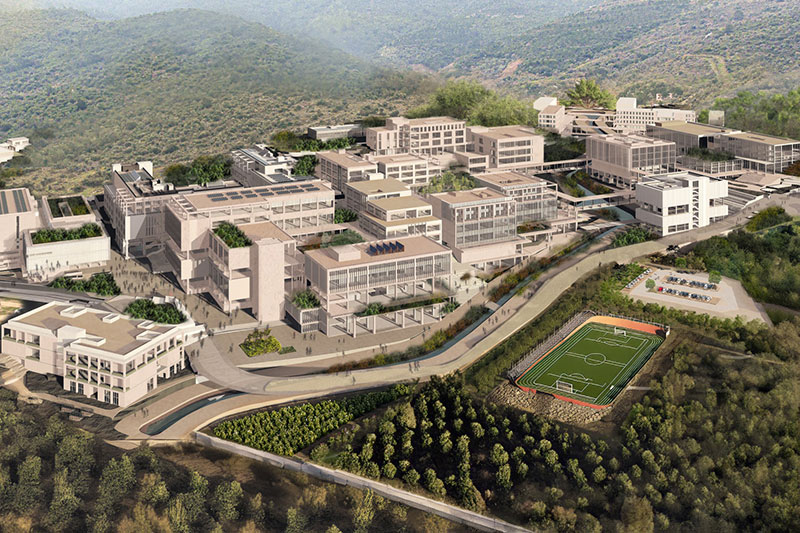
IZMIR UNIVERSITY OF ECONOMICS GÜZELBAHÇE CAMPUS
DetailsGLOBAL CAREER
As Izmir University of Economics transforms into a world-class university, it also raises successful young people with global competence.
More..CONTRIBUTION TO SCIENCE
Izmir University of Economics produces qualified knowledge and competent technologies.
More..VALUING PEOPLE
Izmir University of Economics sees producing social benefit as its reason for existence.
More..
You are one step ahead with your graduate education at Izmir University of Economics.